Brand strategy your team and tools run on.
For businesses who believe in the power of brand
I'm Ben Forman. I built and sold Wrestler, and spent fifteen years on brands like Allbirds, Hyatt, New Zealand Police and Ecostore. Now I work as your brand strategist, and every decision lands in one system your whole team builds from.
A strategist who has built brands and businesses
I work directly with your team, on a project or as your fractional brand strategist. You get the experience of someone who has run an agency, working on your brand without an agency around it.
- Founder of Wrestler, a leading creative agency in New Zealand
- Worked with brands like Allbirds, Hyatt, New Zealand Police and Ecostore
- Sat on the board of TVNZ
- Pioneer in multiple new media ventures
- Startup advisor and investor

Most brand strategy dies in a 30-page deck
Consistent, a brand compounds growth. Scattered, it leaks money.
Two weeks of a strategist and a creative working on your brand. Thousands of words of real thinking, compressed into a deck, handed over, passed around three people, and never opened again. So the brand runs on memory instead.
Your agency has one version, the new hire has another, and sales have invented a third. All of them reasonable but none of them the same, and within months none of them relevant. The work comes back slightly off, you spend a round fixing it, and the campaign you paid six figures for pulls in four directions at once. Sound familiar?
A strategist who makes the calls, and a system that keeps them.
One strategist, amplified
An agency puts a team on your brand because most of the work is reading, reconciling, formatting and keeping things current. Chronicle does that part. It reads everything you have already made, checks every decision against the others, flags drift before it ships, and hands the finished strategy to your AI tools. That leaves me doing the part a team can't share: making the calls with you.
Every decision about your brand, in one place, current
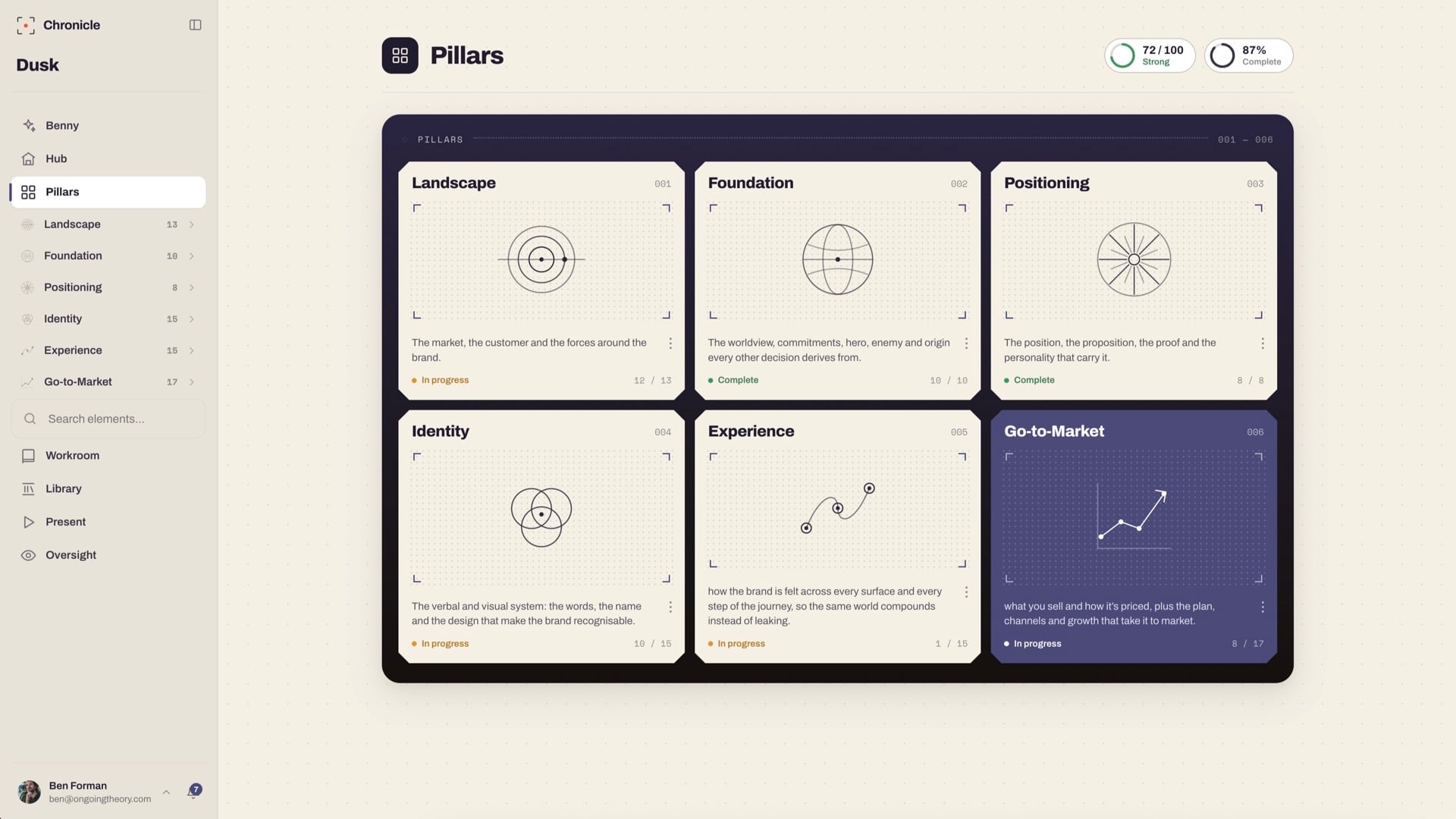
Six pillars hold the elements a brand actually runs on: designed the same way you write a book or a film. Each one is a card you can read, edit, comment on and sign off, with an owner and a date. Nothing lives in a slide someone made in 2023.
Where the work gets made, already on-brand
Ask for a campaign brief, a positioning strategy, a launch plan or a brainstorm. The workroom drafts it against your canvas, cites the elements it drew on, and hands you something a contractor or agency can execute straight away.
My thinking, on hand whenever you need it
Benny is trained on fifteen years of how I approach brand, and works only from your canvas. Ask whether a claim is on-brand, who a line is for, or what the guardrails say, and you get an answer with the elements it came from. When something is missing, Benny drafts it for you to edit and sign off.
Your canvas plugs into the tools your team already writes in
Chronicle serves your signed-off canvas over MCP. An assistant in your writer's editor, your agency's workspace or your own chat window reads the real positioning, tone and guardrails before it drafts a word. No pasting the deck in as context and hoping.
You can see whether the brand is holding
Every element carries a state and a score, so the canvas reports on itself: what is signed off, what is thin, what has drifted since the last review. Oversight rolls that up per pillar, so a quarterly brand review takes an hour instead of a project.
 00000000000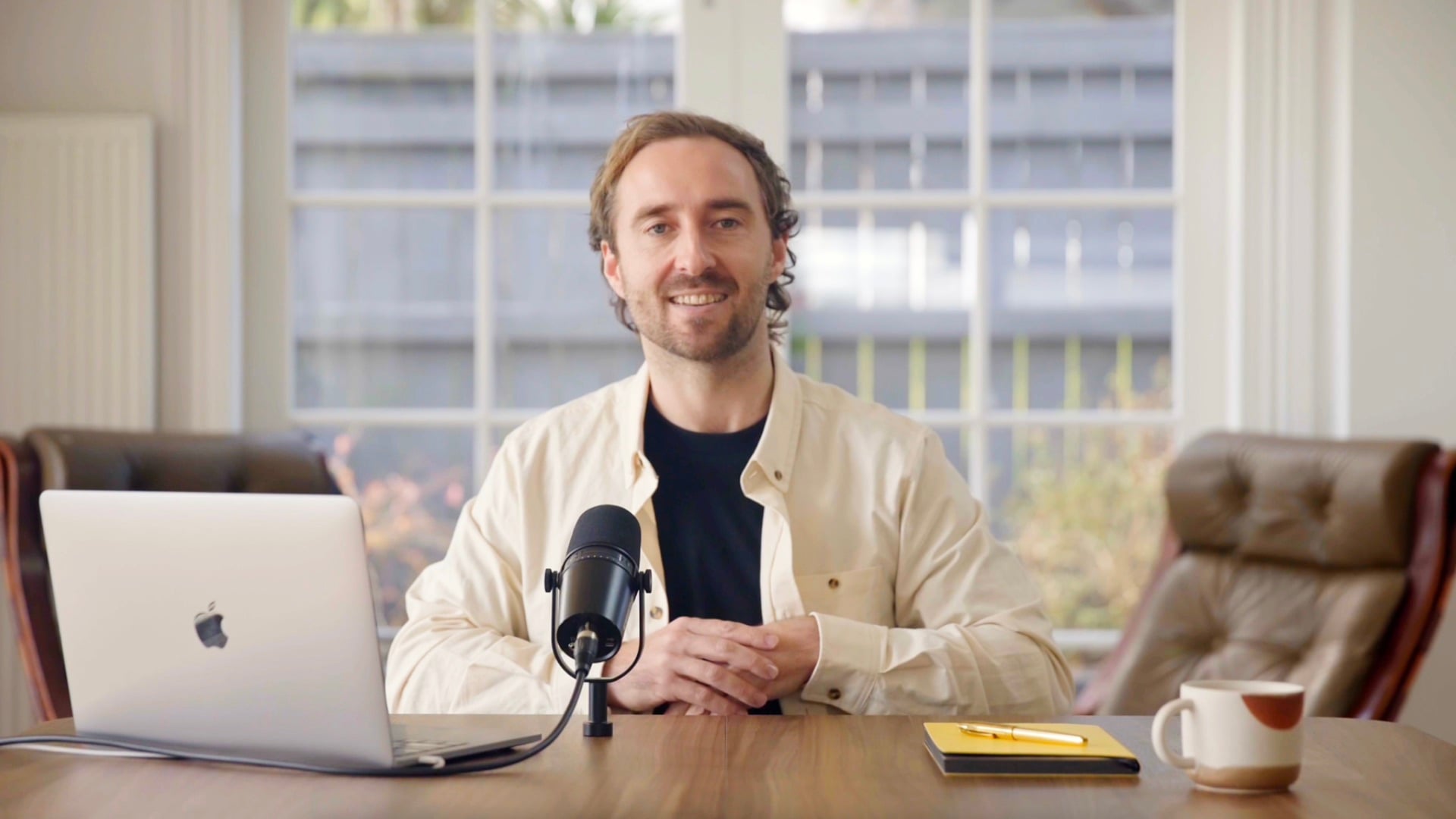
Six pillars, one canvas
The framework I have refined over fifteen years of brand work: six pillars, and the elements a brand actually runs on. Every element is a card you can read, edit and sign off. Here is the whole structure, taken apart.
The market, the customer and the forces around the brand.
We start outside the building. What the market is actually doing, who you are for, who else is competing for that attention, and which shifts are moving in your favour. Everything downstream gets judged against this, so it goes first.
- Market
- Category
- Competitors
- Customer
- Current perception
- Trends
- Business context
- Research plan
- Interviews
- Survey & quant
- Analytics
- Market data
- Brand tracking
The worldview, commitments, hero, enemy and origin every other decision derives from.
The conviction underneath the brand. What you believe, who the hero is, what you refuse to become, and the true origin no competitor can borrow. When a decision is close, this pillar breaks the tie.
- Worldview
- Purpose
- Vision
- Mission
- Values
- Operating principles
- Protagonist
- Enemy
- Territory
- Origin & lore
The position, the proposition, the proof and the personality that carry it.
The space you own in the market and in the mind, the sharpest reason to choose you, and the proof that makes it credible. This is the pillar most briefs quote from, so it gets signed off line by line.
- Positioning statement
- Unique value proposition
- Reasons to believe
- Differentiators
- Brand personality / archetype
- Distinctive assets
- Brand narrative
The verbal and visual system: the words, the name and the design that make the brand recognisable.
How the position is made visible and audible. Logo, colour, type, imagery, tone and the words you own. Your designer or agency executes it; Chronicle holds the rules so it stays consistent between them.
- Name
- Verbal identity
- Tagline
- Key messaging
- Tone of voice
- Lexicon
- Design
- Aesthetic
- Logo
- Colour
- Typography
- Iconography
- Photography
- Video / motion
- Illustration
- Sonic
How the brand is felt across every surface and every step of the journey, so the same world compounds instead of leaking.
Site, social, onboarding, service, the whole journey. Each touchpoint gets scored against the same standard, so the gap between the promise and the experience is visible instead of assumed.
- Website
- Social
- Email / CRM
- PR
- Events
- Sales collateral
- Packaging / environment
- Product interface
- Merch
- Customer journey
- Customer support
- Onboarding
- Retention / loyalty
- Community
- Employer brand
What you sell and how it's priced, plus the plan, channels and growth that take it to market.
Offer, pricing, the twelve-month arc and the channel mix. This is where the brand turns into a plan someone can run next quarter, drafted against everything above it.
- Products
- Services
- Pricing
- Packaging
- Sales
- Partnerships
- 12-month storytelling arc
- Funnel / audience growth
- Budget & resourcing
- Content rollout
- Campaign & activation calendar
- Launch strategy
- Channel & media
- Thought leadership
- Figureheads
- Influencers
- Affiliates
What it costs
Your brand is already out there, across your site, your socials, your decks and every agency you have briefed. I bring all of it into alignment, then build a framework around it, so the brand becomes a lever for growth your whole team can pull.
- An audit of everything your brand already puts out
- A full-day workshop with your team and me
- Every decision about your brand made and aligned, across six pillars and 78 elements
- A framework your team, your agencies and your AI tools all work from
- Every element signed off by you
- Yours to keep, on Chronicle
A new name, a new position, or a business changing direction. Anything bigger than aligning the brand you have gets scoped on the call and quoted to fit.
- Everything in Brand Alignment
- New positioning, messaging and propositions
- Creative direction for how the brand looks, sounds and behaves
- Rounds with you until the new thinking holds
Keeps your canvas live once the project is done. Skip it and the canvas stays on Chronicle for free, as a record your team can read, edit and share.
- Benny, trained on how I work, drafting against your canvas
- Always running on the latest frontier models, upgraded as they ship
- Briefs, campaigns and strategies made in the workroom
- Your signed-off canvas served to any AI tool over MCP
- Brand health scored, so drift surfaces before it ships
- Access for your team, your agencies and your partners
Most brands start with Brand Alignment. If the discovery call turns up a bigger job, I will scope and quote it. Either way, the canvas is yours at the end.
Three hundred and fifty a month is about an hour and a half of a strategist at the going rate. Here it keeps the strategy you paid for working every day, across your team, your agencies and your tools.
A proven process
I start with an audit of where your brand actually stands, then we refine the thinking together. Everything you have already made that still holds true carries straight through, and we build on it until you have a brand you can work confidently from. From there Chronicle keeps it current, and Benny drafts from it whenever you need him.
- Discovery call
- Workshop
- Landscape & research
- Foundation & positioning
- Identity & expression
- Experience & go-to-market
- Sign-off & handover
The whole process is managed inside Chronicle, so you can see progress, outputs and deliverables at every step of the journey.
- 01The workshop
You hand over everything. The old deck, the tone of voice note, the guidelines nobody follows, the strategy that stalled. I read all of it. Everything still true goes into the canvas and gets signed off. Everything that isn't gets cut, and you'll know why.
- 02Your canvas
I build out your canvas with you until every element is signed off and the brand is exactly where you want it to be.
- 03Always On, with Benny
Your team drafts briefs, strategies and campaign concepts from the canvas, and your AI tools read it before they write. When a call needs a strategist again, you know where I am.
You're hiring me. I do the strategy work with your team, the way a senior agency strategist would. Chronicle is how that work gets delivered and kept: you get a living system your team, your agencies and your AI tools build from, and it stays current after the strategy work is done.
I make every call in it, in a workshop with you, and you sign off every element before it counts as true. The engine drafts against those decisions and keeps them usable once the workshop is over. And it runs on a framework built for brand specifically, six pillars and the elements underneath them, so the questions asked and the answers given are the ones a strategist would recognise. A general-purpose AI with no framework and no knowledge of your brand gives you a general-purpose answer.
Three differences. A Notion page is empty until someone fills it in, and this one arrives filled in, built from a day of workshop with your team and everything you already have. Notion also records whatever you type, including the parts that are wrong or out of date, and cutting those is most of the job. And you can't ask Notion for a campaign brief in your own voice with the thinking cited underneath.
No. At the end of the project your canvas is yours, and it stays on Chronicle for free as a record your team can read, edit and share. Always On is optional. It keeps the canvas live, with Benny drafting from it, the workroom making briefs, and your AI tools reading it before they write.
It comes with you, or it gets cut, and you'll know which. Everything still true goes into the canvas and gets signed off by you. The rest gets left behind on purpose, because carrying dead thinking forward is how a brand ends up disagreeing with itself. Most people have more than they think. It is just scattered.
No. Everything before execution, nothing after it. You leave with the thinking your designer, agency or content partner needs, and you keep whoever you already trust to make the work.
About a month from workshop to handover, depending on the scale of the project.
That's the job. Bring the mess to the discovery call. I'll scope it out and tell you what I can take on, and where a partner is the better fit.